When a product turns out to be unsafe
A recall is judged on three things: speed, proportionality and documentation. Move too slowly and the hazard keeps reaching people; over-react and you burn trust and money; fail to document and you cannot show a regulator — or a retailer — that you acted responsibly.
This paper turns the recall from a panic into a process. It walks through the full lifecycle — detect, assess, decide, notify, communicate, execute, monitor and close out — in the EU context of the General Product Safety Regulation (GPSR) and the EU Safety Gate. Every phase comes with the concrete tasks it contains, why each one matters, and a worked example from a single running scenario: a Bluetooth kettle whose thermal cut-off can fail.
The final section shows how to run and automatically document the whole thing in Conphora’s recall workspace — so the paper trail a recall demands is produced as a by-product of doing the work, not a scramble afterwards.
General guidance, not legal advice. Requirements vary by product type and market — confirm specifics with the competent authority (see Conphora → Tools → Compliance resources).
Why recalls matter now in the EU
Product safety in the EU has moved from a back-office obligation to a front-line condition of market access. Two forces drive it.
A stricter, broader framework
The General Product Safety Regulation (GPSR, (EU) 2023/988) has applied since 13 December 2024, replacing the old General Product Safety Directive. It tightens the duties of manufacturers, importers and distributors, extends obligations to online marketplaces, and makes clear that when a product is dangerous, economic operators must take corrective action and inform both consumers and authorities — promptly and traceably.
Visible, rising enforcement
The EU’s rapid-alert system, Safety Gate, publishes dangerous-product alerts every week and is fed by national authorities and by economic operators through the Safety Business Gateway. The volume is large and growing — a signal that surveillance and cross-border action are intensifying, not relaxing.
By the numbers. 4,137 Safety Gate alerts in 2024 — nearly double the 2022 figure. A single product recall can cost millions in direct logistics, remediation and lost sales, before reputational damage. Consumers pay a measurable premium for products they trust.
This paper names the framework but does not assert member-state-specific deadlines or penalties — those vary. Treat the GPSR/Safety Gate references as orientation and confirm the specifics for your product and markets with the competent authority.
Recall, withdrawal, notice or retrofit?
Choosing the right action — the lightest one that genuinely controls the risk — starts with knowing the difference.
- What a recall is — and isn’t. A recall gets an unsafe product back from, or fixed in, the field. It differs from a withdrawal, a safety notice/warning, and a retrofit/repair-in-place. Choose the lightest action that actually controls the risk.
- Withdrawal. Pulling a product from sale and the supply chain before it reaches consumers. Appropriate when stock is still in your control — but it does nothing for units already with customers.
- Safety notice / warning. Telling users how to use a product safely, or what to avoid, without taking it back. Suitable only for low-severity risks that instructions can genuinely mitigate.
- Retrofit / repair-in-place. Fixing the product where it is — a replacement part, a firmware update, an on-site repair. Powerful when the fix is simple and the unit need not come back.
Worked example. “Full recall for repair — a withdrawal alone won’t reach units already with customers.”
When to recall — and how to think
- When to recall. Risk-based triggers: a hazard that can cause injury, a pattern of failures, or a non-compliance affecting safety. Decide on severity × probability × exposure, and write down the reasoning.
- First principles. Act fast; be proportionate; document everything; keep traceability (batch/serial/date codes); name one coordinator; work from one written action plan.
- Roles & responsibilities. Coordinator, quality/engineering, legal/regulatory, communications, logistics/reverse-logistics, customer service — agree who owns what before the clock starts.
- One coordinator, one plan. Make a single person accountable for decisions and run everything from one written action plan. Recalls fail on diffuse ownership more than on technical difficulty.
Worked example — rating the risk. “Severity: high (burns). Probability: low. Exposure: 12,000 units sold. → Overall: medium-high.”
The eight-phase recall lifecycle
Eight phases, each with its own tasks. This is the spine of a recall: creating a case in Conphora seeds exactly these steps, so nothing is missed. Each task below carries what it means and a worked example from the running kettle scenario.
1 · Detect & triage
Capture the signal, log it, and decide if it needs action.
- Log the safety signal / complaint — source, date, what was reported, how many reports. Why: record the first sign that something may be wrong, so there is a dated, traceable starting point.
- Assemble the recall team & name a coordinator — quality, legal, comms, logistics, customer service. Why: bring together the people who will run the recall and make ONE person accountable for decisions.
- Preserve evidence & affected samples — quarantine stock; keep the defective units for analysis. Why: stop affected stock from moving and keep faulty units so you can investigate the root cause later.
Example. “3 customers reported the kettle base getting hot enough to discolour the worktop; first report 12 May.”
2 · Risk assessment
Understand the hazard, who is exposed, and how bad it is.
- Identify the hazard & failure mode — what can go wrong, under what conditions. Why: describe exactly what fails and the harm it can cause — the basis for every decision that follows.
- Rate severity × probability × exposure — use a documented risk matrix; record the rationale.
- Define affected units (batch/SKU/serial/date range) — trace production and distribution records, so you neither over- nor under-recall.
- Decide the corrective action — recall vs withdrawal vs safety notice vs retrofit, proportionate to risk.
Example. “Thermal cut-off fails to trip → base overheats → burn / fire risk.” · “Model K12, batches 2451–2480, manufactured Jan–Mar 2026, sold in DK/SE.”
3 · Decision & strategy
Set the plan: scope, remedy, timeline, owners, budget.
- Choose the remedy — repair, replace, refund or destroy — and the return/reverse-logistics route.
- Set timeline, owners & budget — assign an owner and a date to every step so the recall keeps momentum.
- Write the recall action plan — a single document the whole team works from, so nothing is improvised.
Example. “Free replacement base unit shipped with a prepaid return label for the old one. Notice live by 20 May; returns portal open 21 May; budget €60k.”
4 · Notify authorities & supply chain
Tell the people who must know — where required.
- Notify the competent authority (where required) — use the official channel for your market(s), usually before you go public.
- Notify distributors, retailers & marketplaces — ask them to stop sales and pass the notice to customers.
- Stop sales & block stock — pull from shelves, online listings and your own channels.
EU. Economic operators report a dangerous product and the corrective action taken through the Safety Business Gateway, which feeds Safety Gate. Notify before or as you go public, where required.
5 · Customer & public communication
Reach the people holding the product, clearly and fast.
- Draft the recall notice — product + images, identifiers, the hazard, what to do now, the remedy, how to claim, contact.
- Choose channels — website notice, email to registered owners, retailer POS, social, press, packaging.
- Publish the notice & open a support route — a hotline, form or page so customers can act.
6 · Execute the remedy
Run the returns, repairs, replacements or refunds.
- Operate the return / repair / refund process — track each unit through the chosen remedy.
- Track units recovered vs affected — keep a running count of how many affected units you have recovered or fixed.
Example. “Returns portal issues labels; replacements ship within 3 days; each RMA logged. 1,920 of 12,000 returned after week 1 (16%).“
7 · Monitor effectiveness
Measure whether the recall is actually working.
- Measure response / recovery rate — track it against a target so you know whether the recall is working.
- Escalate if response stalls — more channels, reminders, incentives; inform the authority if needed.
Example. “Target 60% in 8 weeks; currently 38% at week 4 — on track.” · “Response flat at 40% → second email + €10 voucher; informed authority of revised plan.”
8 · Close-out & lessons learned
Root cause, CAPA, final report, retain records.
- Complete root-cause analysis — establish why it happened and why it was not caught earlier.
- Define & assign corrective/preventive actions (CAPA) — so it cannot recur, with owners.
- Write the close-out report — outcome, recovery rate, costs, CAPA. Share with the authority if required.
- Archive all records for the retention period — decisions, notices, correspondence, evidence.
Example. “Supplier changed the thermostat without notice; incoming QC didn’t test cut-off temperature. Close-out: 71% recovered, no injuries, cost €74k, 2 CAPAs open with due dates.”
The recall notice — what it must contain
The notice is the single most important customer-facing artefact of a recall. In plain language, prominent and accessible, it must carry everything a person holding the product needs to act:
- Product name and clear images
- Identifiers: model, batch, serial or date range
- The hazard and what could happen
- What the customer should do now (stop using it)
- The remedy: refund, replacement or repair
- How to claim, plus contact details
Example notice. “Includes photo, model/batch, the hazard, ‘stop using it now’, refund/replace, and a hotline.”
Run — and document — it in Conphora
Everything above is built into Tools → Product recall. Create a case and it seeds the eight phases and every task; work the board; record how each step was done; track recovery; and export a complete, branded report.
- Recall overview. Every recall in one place, with live status, risk and a task-progress bar.
- Create a recall. Open a case in seconds (title, product, identifiers, markets, hazard, risk) — it seeds the full phased task list automatically.
- The phased task board. The eight-phase lifecycle as a working checklist, with per-task status and assignment.
- Built-in guidance. Each template task carries an “i” panel with its explanation and a worked example.
- Per-task notes. Record how each step was done — decisions, who, when, links — your audit trail.
- Units affected vs recovered. Track both figures and a live recovery rate as the recall progresses.
- Automatic timeline. Every change — status, note, field edit — is logged into an append-only timeline.
- One-click report. Turn the whole case — overview, every task with its notes, and the full timeline — into a documented, Conphora-branded PDF.
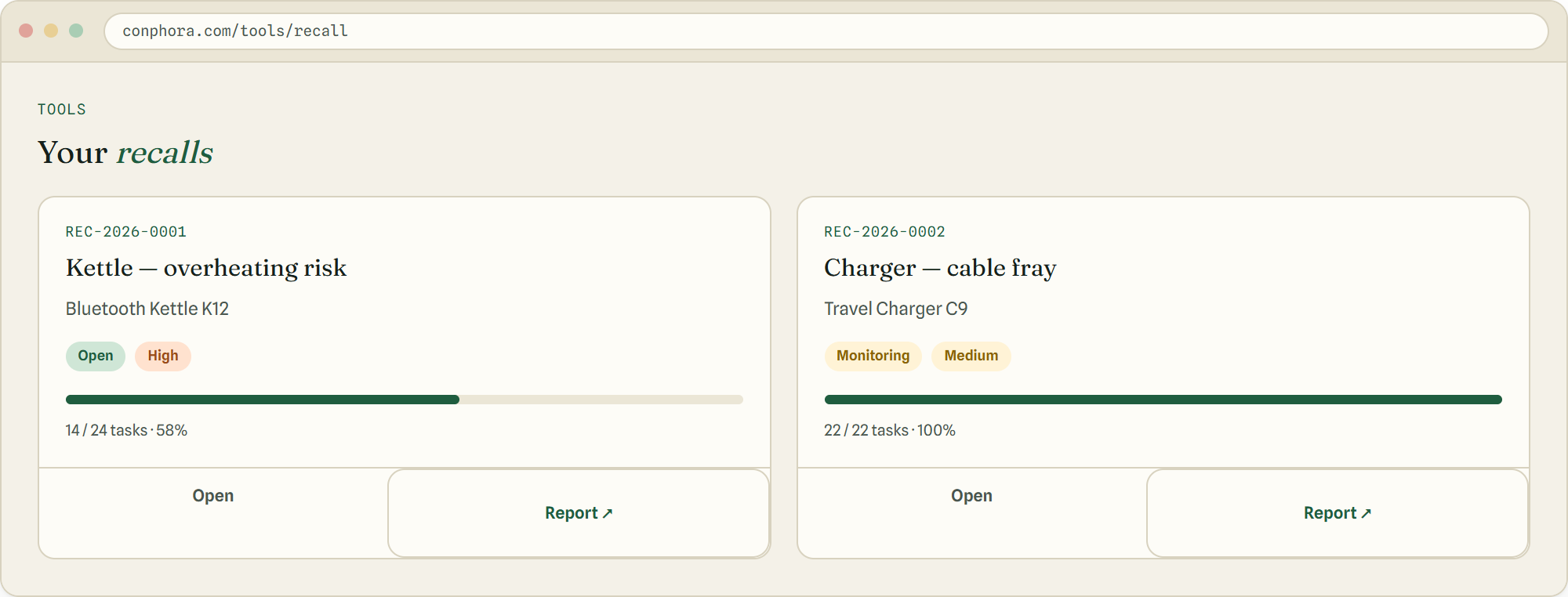
Figure 1. Every recall in one place, with live status, risk and progress.
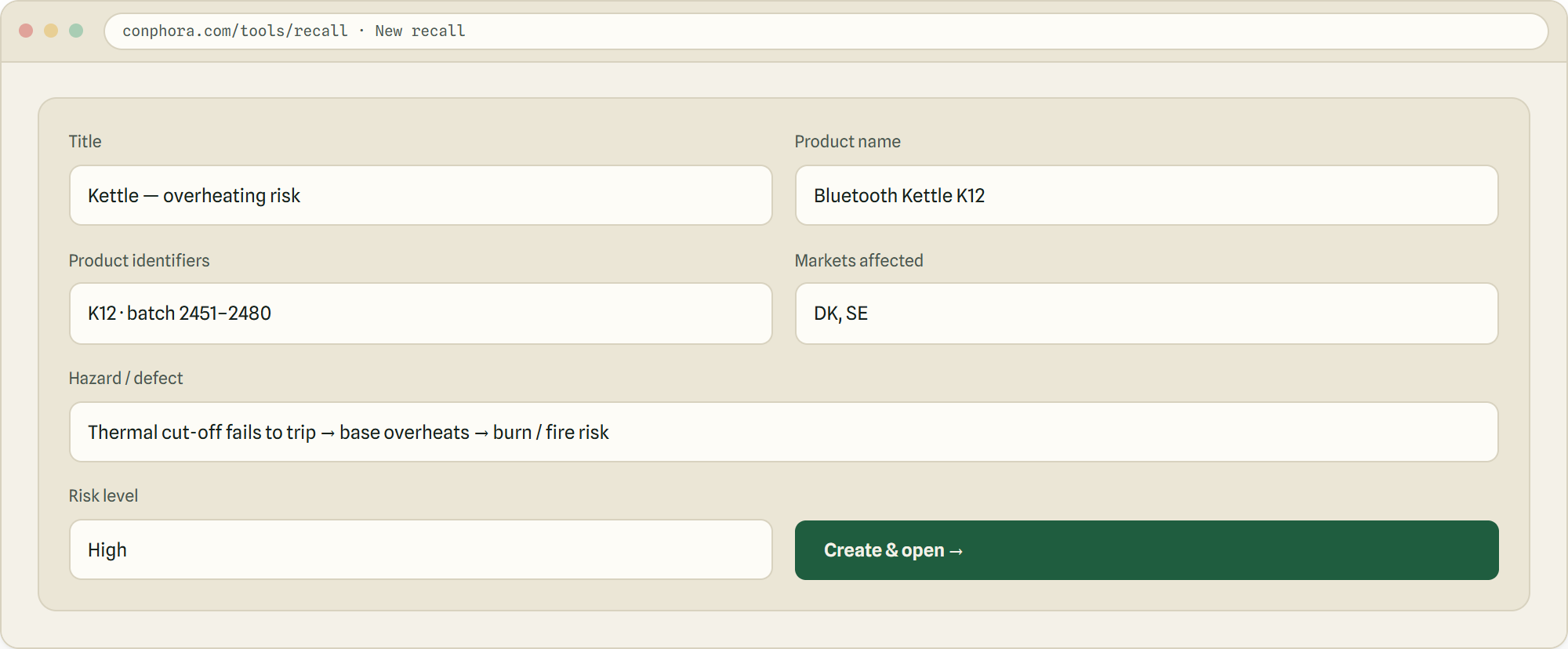
Figure 2. Open a case in seconds — it seeds the full phased task list automatically.
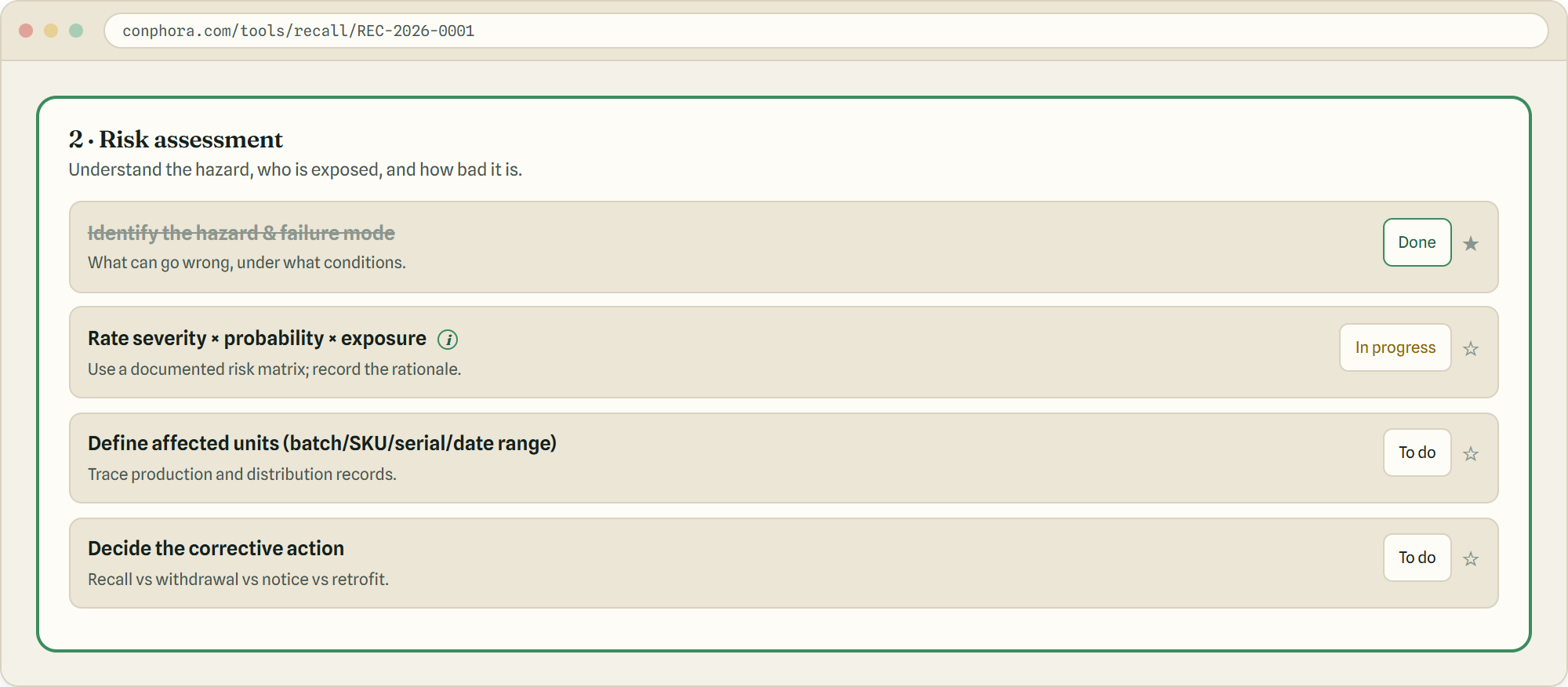
Figure 3. The eight-phase lifecycle as a working checklist with per-task status and assignment.
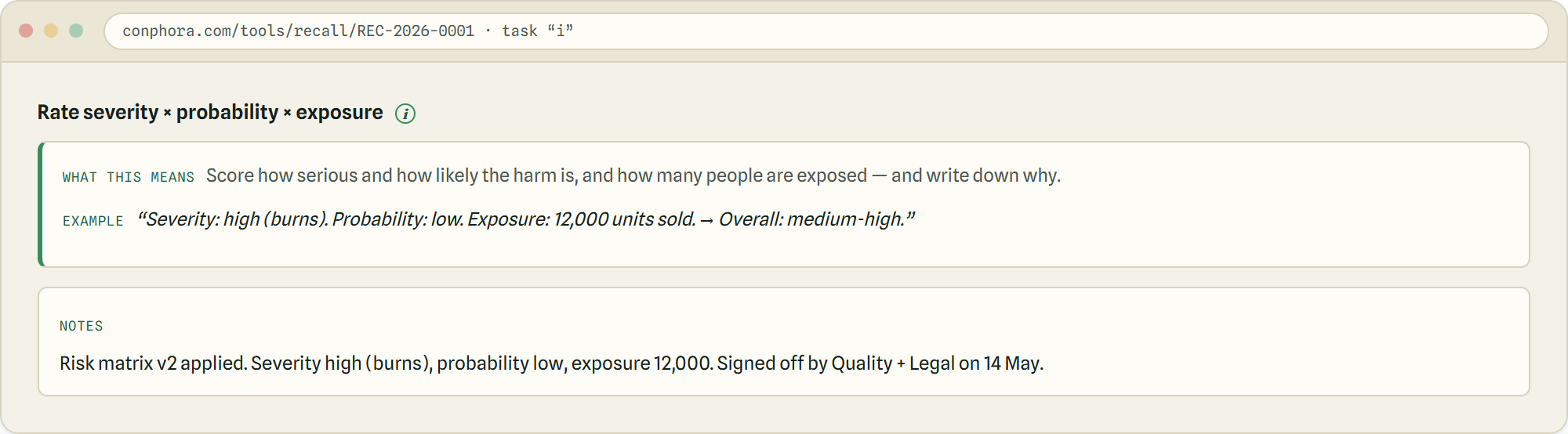
Figure 4. Each step explains itself with a worked example (the “i” icon), and a notes field records how it was actually done — your audit trail.
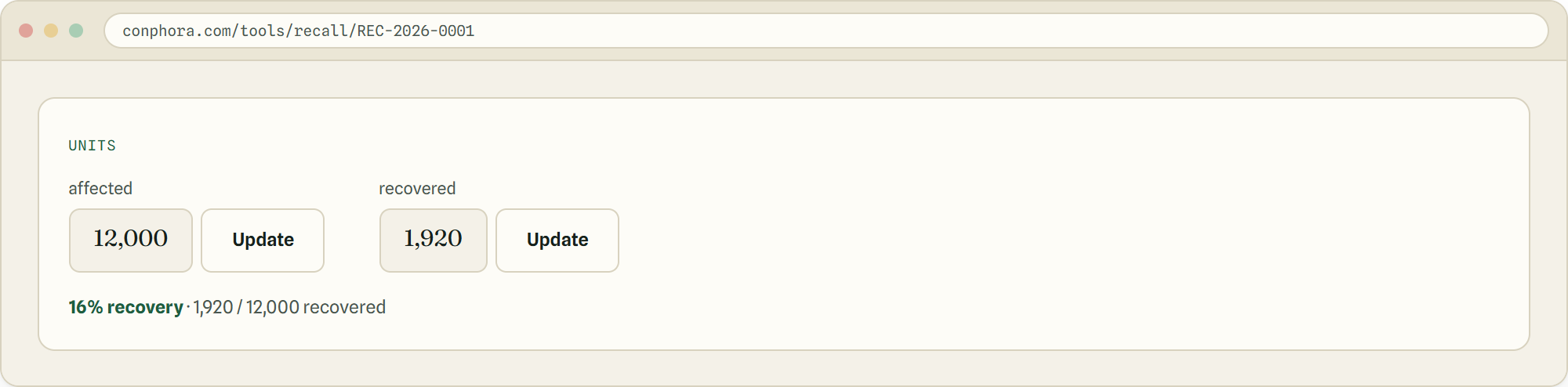
Figure 5. Track recovered against affected units in real time — the number that tells you whether the recall is working.
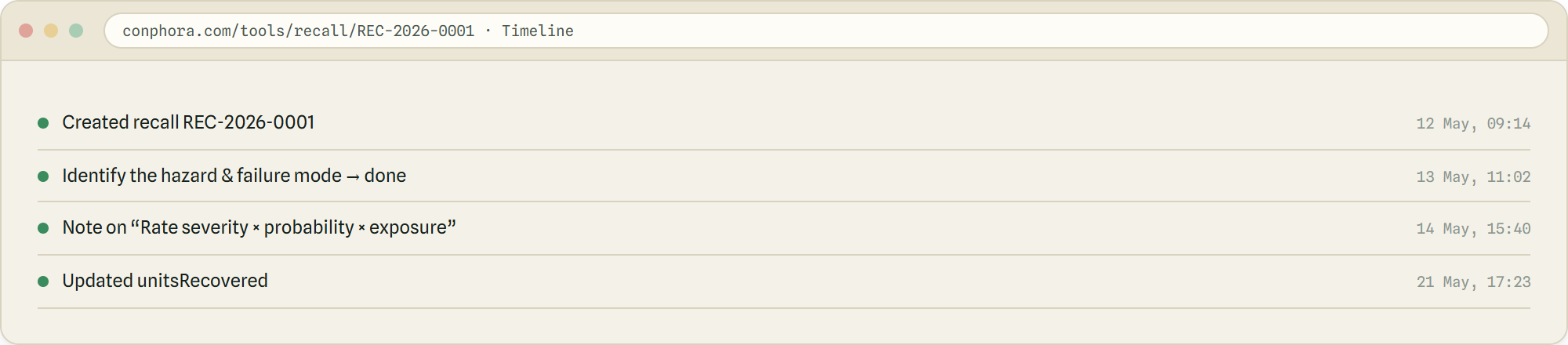
Figure 6. Every change — status, note, field edit — is logged automatically into an append-only timeline.
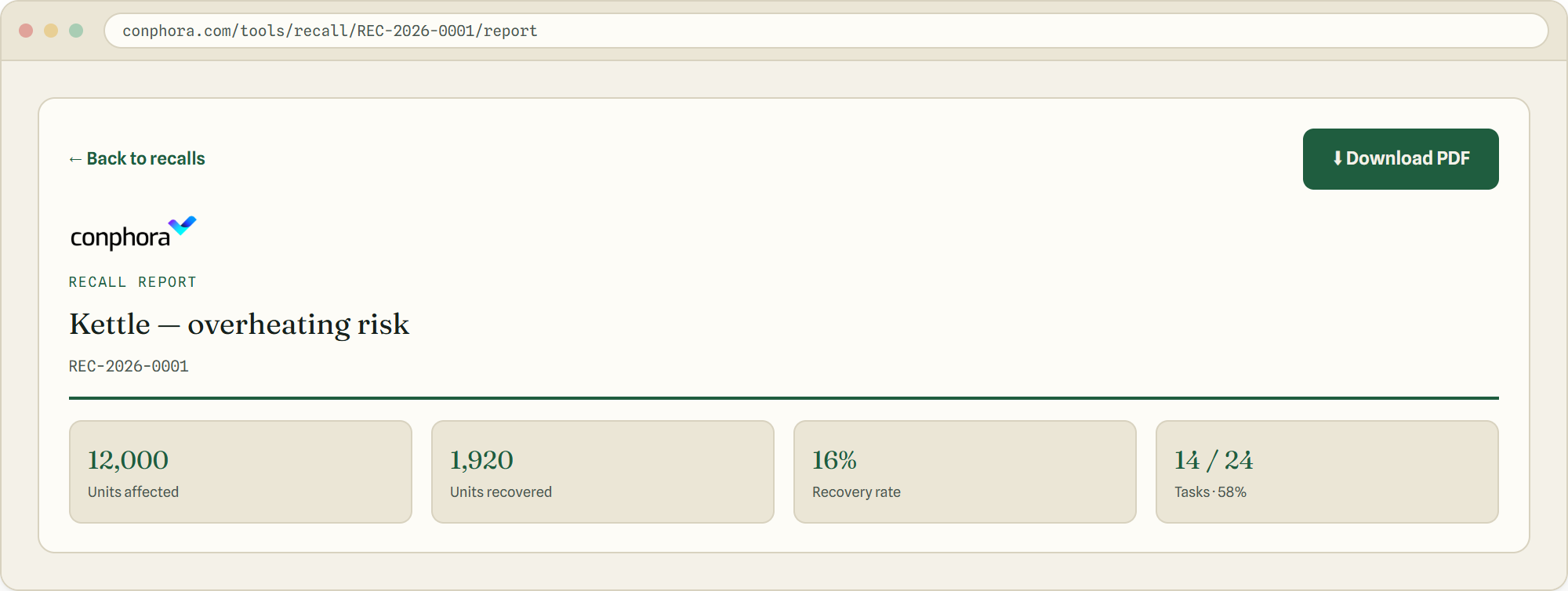
Figure 7. One click turns the whole case — overview, every task with its notes, and the full timeline — into a documented, Conphora-branded PDF.
Common pitfalls
- Moving too slowly. The hazard keeps reaching people while you deliberate. Act fast, then refine.
- Underestimating scope. Define affected units precisely from batch/serial/date records — guessing low leaves dangerous units in the field.
- Vague notices. If a customer can’t tell whether they’re affected or what to do, the notice has failed.
- No single owner. Diffuse ownership stalls decisions. Name one coordinator.
- Stopping at “announced”. A recall is done when units are controlled, not when it’s published — keep measuring recovery.
- Poor record-keeping. If you can’t show what you did and when, you can’t demonstrate you acted responsibly.
Ready to turn the next recall into a process, not a panic? Start at conphora.com/tools/recall.
Sources & framework: General Product Safety Regulation (EU) 2023/988 (via EUR-Lex); European Commission — Safety Gate & Safety Business Gateway; and Conphora’s regulation-agnostic recall framework. General guidance, not legal advice — confirm specifics with the competent authority. © 2026 Conphora.