General guidance, not legal advice. Requirements vary by product type and market — confirm specifics with the competent authority (see Conphora → Tools → Compliance resources).
## Why recalls matter now in the EU Product safety in the EU has moved from a back-office obligation to a front-line condition of market access. Two forces drive it. ### A stricter, broader framework The **General Product Safety Regulation (GPSR, (EU) 2023/988)** has applied since **13 December 2024**, replacing the old General Product Safety Directive. It tightens the duties of manufacturers, importers and distributors, extends obligations to online marketplaces, and makes clear that when a product is dangerous, economic operators must take corrective action and inform both consumers and authorities — promptly and traceably. ### Visible, rising enforcement The EU's rapid-alert system, **Safety Gate**, publishes dangerous-product alerts every week and is fed by national authorities and by economic operators through the **Safety Business Gateway**. The volume is large and growing — a signal that surveillance and cross-border action are intensifying, not relaxing. > **By the numbers.** 4,137 Safety Gate alerts in 2024 — nearly double the 2022 figure. A single product recall can cost millions in direct logistics, remediation and lost sales, before reputational damage. Consumers pay a measurable premium for products they trust. This paper names the framework but does not assert member-state-specific deadlines or penalties — those vary. Treat the GPSR/Safety Gate references as orientation and confirm the specifics for your product and markets with the competent authority. ## Recall, withdrawal, notice or retrofit? Choosing the right action — the lightest one that genuinely controls the risk — starts with knowing the difference. - **What a recall is — and isn't.** A recall gets an unsafe product back from, or fixed in, the field. It differs from a withdrawal, a safety notice/warning, and a retrofit/repair-in-place. Choose the lightest action that actually controls the risk. - **Withdrawal.** Pulling a product from sale and the supply chain *before* it reaches consumers. Appropriate when stock is still in your control — but it does nothing for units already with customers. - **Safety notice / warning.** Telling users how to use a product safely, or what to avoid, without taking it back. Suitable only for low-severity risks that instructions can genuinely mitigate. - **Retrofit / repair-in-place.** Fixing the product where it is — a replacement part, a firmware update, an on-site repair. Powerful when the fix is simple and the unit need not come back. > **Worked example.** "Full recall for repair — a withdrawal alone won't reach units already with customers." ## When to recall — and how to think - **When to recall.** Risk-based triggers: a hazard that can cause injury, a pattern of failures, or a non-compliance affecting safety. Decide on severity × probability × exposure, and write down the reasoning. - **First principles.** Act fast; be proportionate; document everything; keep traceability (batch/serial/date codes); name one coordinator; work from one written action plan. - **Roles & responsibilities.** Coordinator, quality/engineering, legal/regulatory, communications, logistics/reverse-logistics, customer service — agree who owns what before the clock starts. - **One coordinator, one plan.** Make a single person accountable for decisions and run everything from one written action plan. Recalls fail on diffuse ownership more than on technical difficulty. > **Worked example — rating the risk.** "Severity: high (burns). Probability: low. Exposure: 12,000 units sold. → Overall: medium-high." ## The eight-phase recall lifecycle Eight phases, each with its own tasks. This is the spine of a recall: creating a case in Conphora seeds exactly these steps, so nothing is missed. Each task below carries what it means and a worked example from the running kettle scenario. ### 1 · Detect & triage *Capture the signal, log it, and decide if it needs action.* - **Log the safety signal / complaint** — source, date, what was reported, how many reports. *Why:* record the first sign that something may be wrong, so there is a dated, traceable starting point. - **Assemble the recall team & name a coordinator** — quality, legal, comms, logistics, customer service. *Why:* bring together the people who will run the recall and make ONE person accountable for decisions. - **Preserve evidence & affected samples** — quarantine stock; keep the defective units for analysis. *Why:* stop affected stock from moving and keep faulty units so you can investigate the root cause later. > **Example.** "3 customers reported the kettle base getting hot enough to discolour the worktop; first report 12 May." ### 2 · Risk assessment *Understand the hazard, who is exposed, and how bad it is.* - **Identify the hazard & failure mode** — what can go wrong, under what conditions. *Why:* describe exactly what fails and the harm it can cause — the basis for every decision that follows. - **Rate severity × probability × exposure** — use a documented risk matrix; record the rationale. - **Define affected units (batch/SKU/serial/date range)** — trace production and distribution records, so you neither over- nor under-recall. - **Decide the corrective action** — recall vs withdrawal vs safety notice vs retrofit, proportionate to risk. > **Example.** "Thermal cut-off fails to trip → base overheats → burn / fire risk." · "Model K12, batches 2451–2480, manufactured Jan–Mar 2026, sold in DK/SE." ### 3 · Decision & strategy *Set the plan: scope, remedy, timeline, owners, budget.* - **Choose the remedy** — repair, replace, refund or destroy — and the return/reverse-logistics route. - **Set timeline, owners & budget** — assign an owner and a date to every step so the recall keeps momentum. - **Write the recall action plan** — a single document the whole team works from, so nothing is improvised. > **Example.** "Free replacement base unit shipped with a prepaid return label for the old one. Notice live by 20 May; returns portal open 21 May; budget €60k." ### 4 · Notify authorities & supply chain *Tell the people who must know — where required.* - **Notify the competent authority (where required)** — use the official channel for your market(s), usually before you go public. - **Notify distributors, retailers & marketplaces** — ask them to stop sales and pass the notice to customers. - **Stop sales & block stock** — pull from shelves, online listings and your own channels. > **EU.** Economic operators report a dangerous product and the corrective action taken through the **Safety Business Gateway**, which feeds **Safety Gate**. Notify before or as you go public, where required. ### 5 · Customer & public communication *Reach the people holding the product, clearly and fast.* - **Draft the recall notice** — product + images, identifiers, the hazard, what to do now, the remedy, how to claim, contact. - **Choose channels** — website notice, email to registered owners, retailer POS, social, press, packaging. - **Publish the notice & open a support route** — a hotline, form or page so customers can act. ### 6 · Execute the remedy *Run the returns, repairs, replacements or refunds.* - **Operate the return / repair / refund process** — track each unit through the chosen remedy. - **Track units recovered vs affected** — keep a running count of how many affected units you have recovered or fixed. > **Example.** "Returns portal issues labels; replacements ship within 3 days; each RMA logged. 1,920 of 12,000 returned after week 1 (16%)." ### 7 · Monitor effectiveness *Measure whether the recall is actually working.* - **Measure response / recovery rate** — track it against a target so you know whether the recall is working. - **Escalate if response stalls** — more channels, reminders, incentives; inform the authority if needed. > **Example.** "Target 60% in 8 weeks; currently 38% at week 4 — on track." · "Response flat at 40% → second email + €10 voucher; informed authority of revised plan." ### 8 · Close-out & lessons learned *Root cause, CAPA, final report, retain records.* - **Complete root-cause analysis** — establish why it happened and why it was not caught earlier. - **Define & assign corrective/preventive actions (CAPA)** — so it cannot recur, with owners. - **Write the close-out report** — outcome, recovery rate, costs, CAPA. Share with the authority if required. - **Archive all records for the retention period** — decisions, notices, correspondence, evidence. > **Example.** "Supplier changed the thermostat without notice; incoming QC didn't test cut-off temperature. Close-out: 71% recovered, no injuries, cost €74k, 2 CAPAs open with due dates." ## The recall notice — what it must contain The notice is the single most important customer-facing artefact of a recall. In plain language, prominent and accessible, it must carry everything a person holding the product needs to act: - Product name and clear images - Identifiers: model, batch, serial or date range - The hazard and what could happen - What the customer should do now (stop using it) - The remedy: refund, replacement or repair - How to claim, plus contact details > **Example notice.** "Includes photo, model/batch, the hazard, 'stop using it now', refund/replace, and a hotline." ## Run — and document — it in Conphora Everything above is built into **[Tools → Product recall](/tools/recall)**. Create a case and it seeds the eight phases and every task; work the board; record how each step was done; track recovery; and export a complete, branded report. - **Recall overview.** Every recall in one place, with live status, risk and a task-progress bar. - **Create a recall.** Open a case in seconds (title, product, identifiers, markets, hazard, risk) — it seeds the full phased task list automatically. - **The phased task board.** The eight-phase lifecycle as a working checklist, with per-task status and assignment. - **Built-in guidance.** Each template task carries an "i" panel with its explanation and a worked example. - **Per-task notes.** Record how each step was done — decisions, who, when, links — your audit trail. - **Units affected vs recovered.** Track both figures and a live recovery rate as the recall progresses. - **Automatic timeline.** Every change — status, note, field edit — is logged into an append-only timeline. - **One-click report.** Turn the whole case — overview, every task with its notes, and the full timeline — into a documented, Conphora-branded PDF. 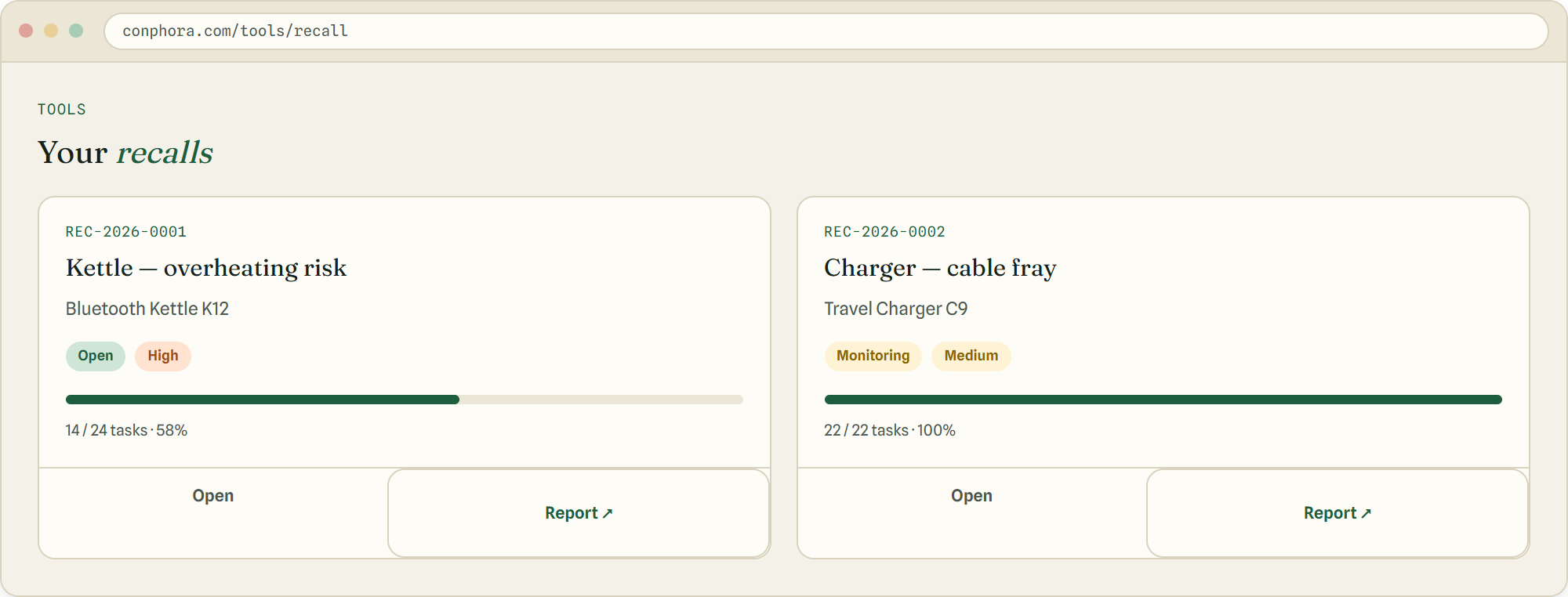 *Figure 1. Every recall in one place, with live status, risk and progress.* 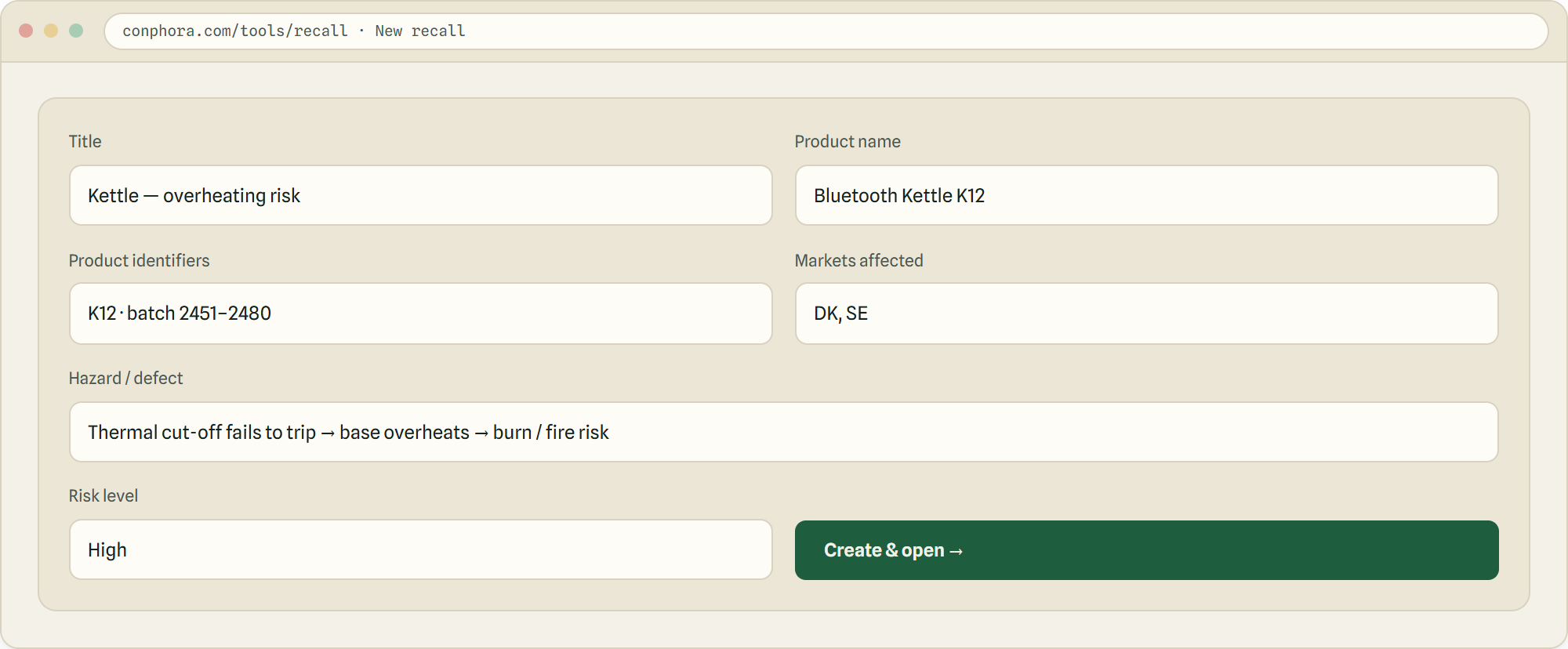 *Figure 2. Open a case in seconds — it seeds the full phased task list automatically.* 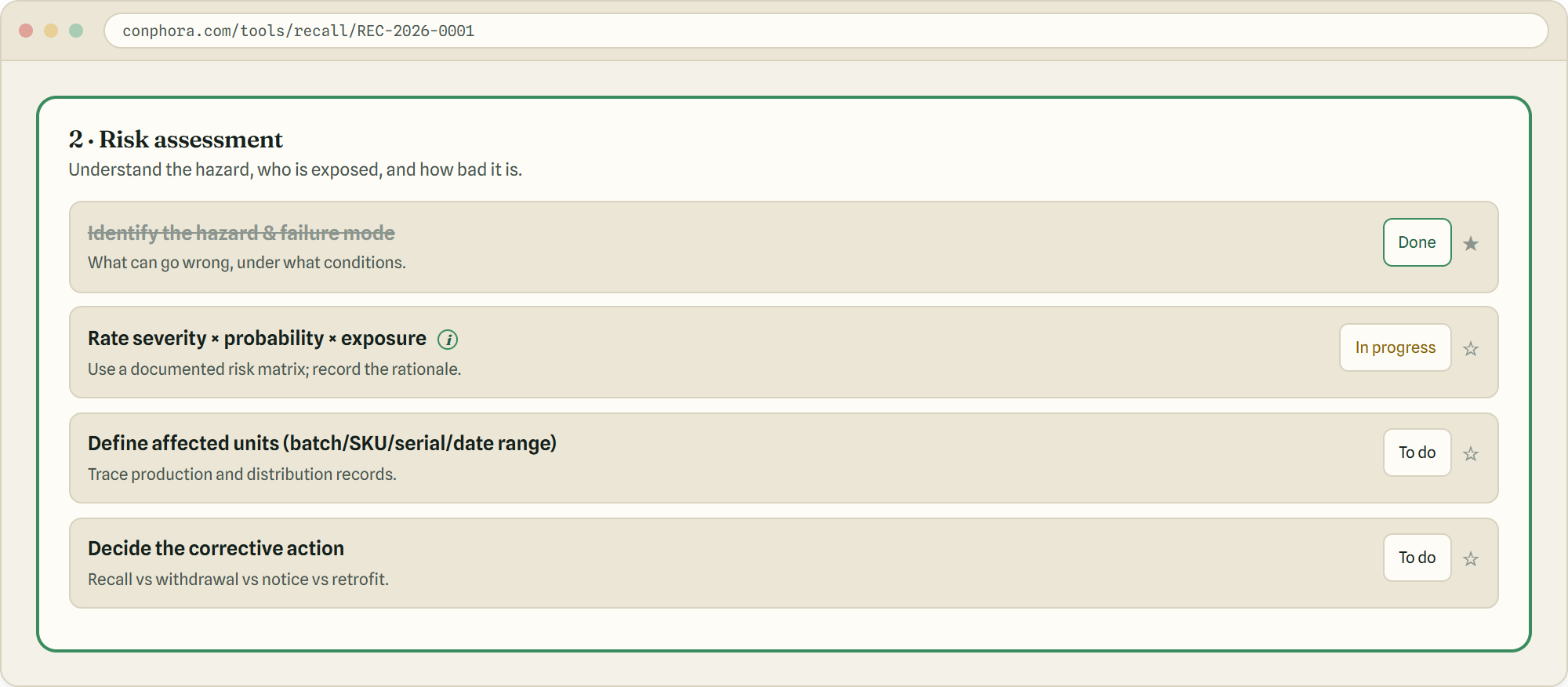 *Figure 3. The eight-phase lifecycle as a working checklist with per-task status and assignment.* 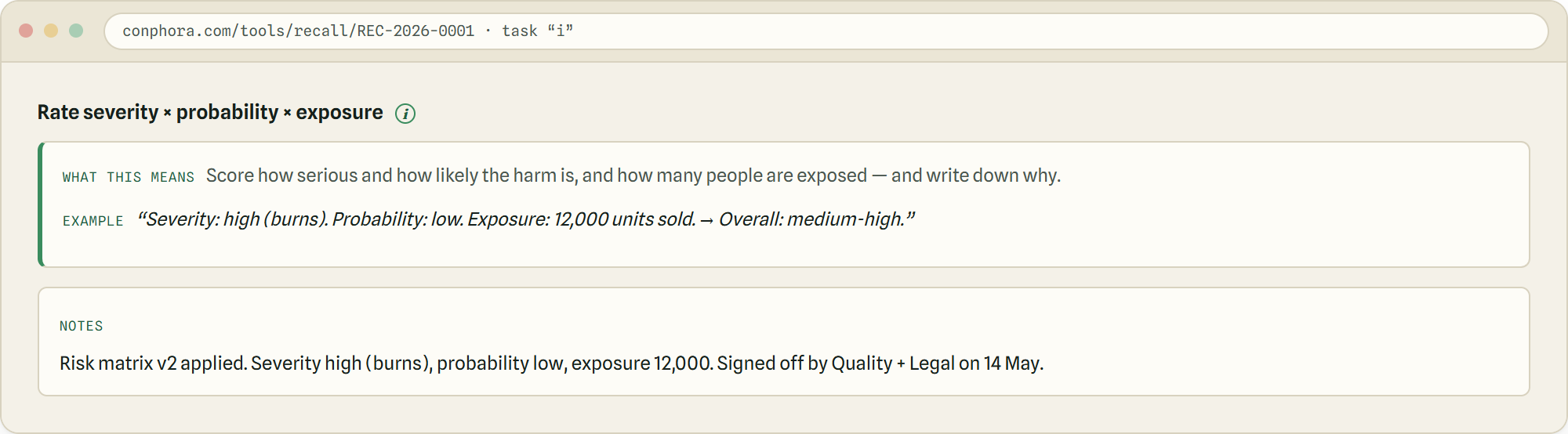 *Figure 4. Each step explains itself with a worked example (the "i" icon), and a notes field records how it was actually done — your audit trail.* 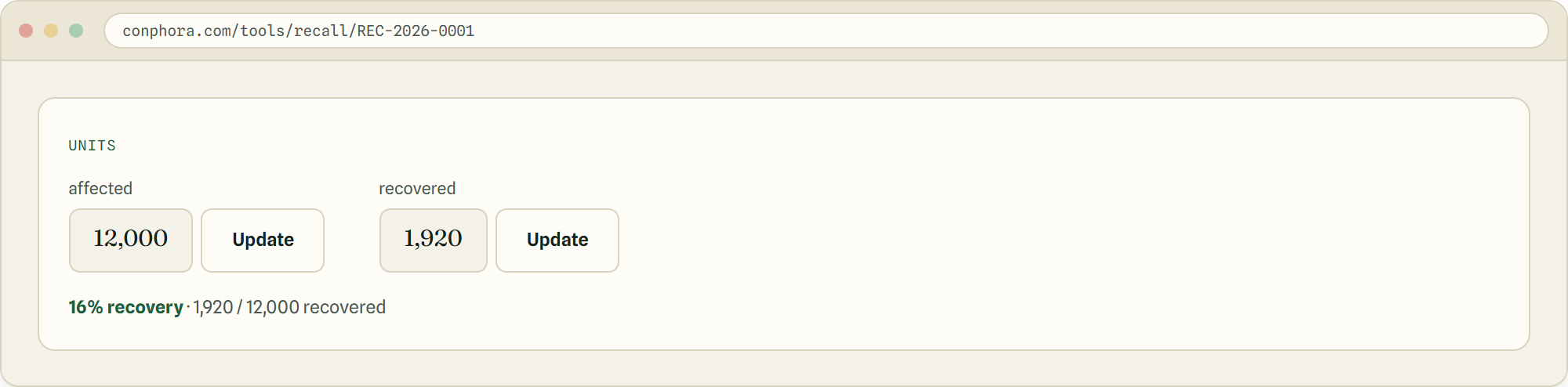 *Figure 5. Track recovered against affected units in real time — the number that tells you whether the recall is working.* 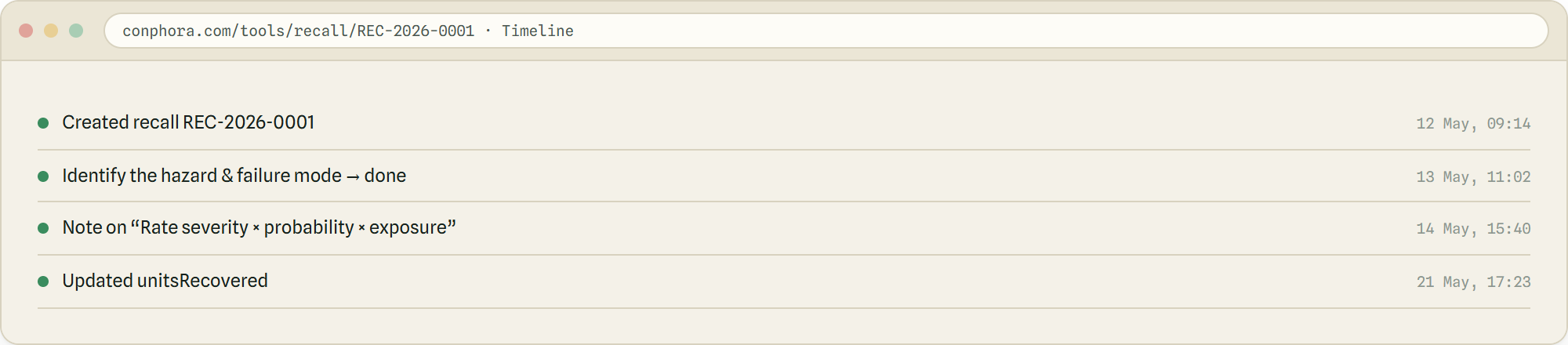 *Figure 6. Every change — status, note, field edit — is logged automatically into an append-only timeline.* 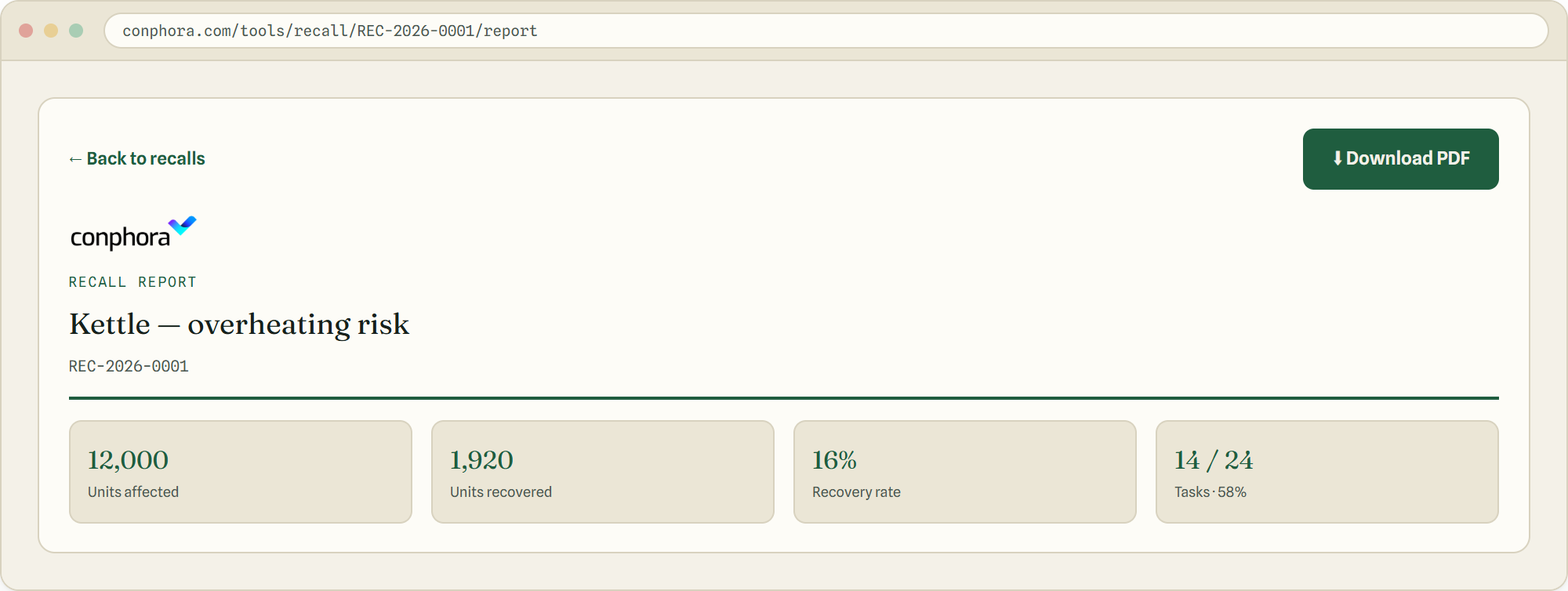 *Figure 7. One click turns the whole case — overview, every task with its notes, and the full timeline — into a documented, Conphora-branded PDF.* ## Common pitfalls - **Moving too slowly.** The hazard keeps reaching people while you deliberate. Act fast, then refine. - **Underestimating scope.** Define affected units precisely from batch/serial/date records — guessing low leaves dangerous units in the field. - **Vague notices.** If a customer can't tell whether they're affected or what to do, the notice has failed. - **No single owner.** Diffuse ownership stalls decisions. Name one coordinator. - **Stopping at "announced".** A recall is done when units are controlled, not when it's published — keep measuring recovery. - **Poor record-keeping.** If you can't show what you did and when, you can't demonstrate you acted responsibly. --- Ready to turn the next recall into a process, not a panic? Start at **[conphora.com/tools/recall](/tools/recall)**.Sources & framework: General Product Safety Regulation (EU) 2023/988 (via EUR-Lex); European Commission — Safety Gate & Safety Business Gateway; and Conphora's regulation-agnostic recall framework. General guidance, not legal advice — confirm specifics with the competent authority. © 2026 Conphora.
PDF: https://www.conphora.com/compliance-information/Conphora_Whitepaper_Product_Recalls_EU.pdf